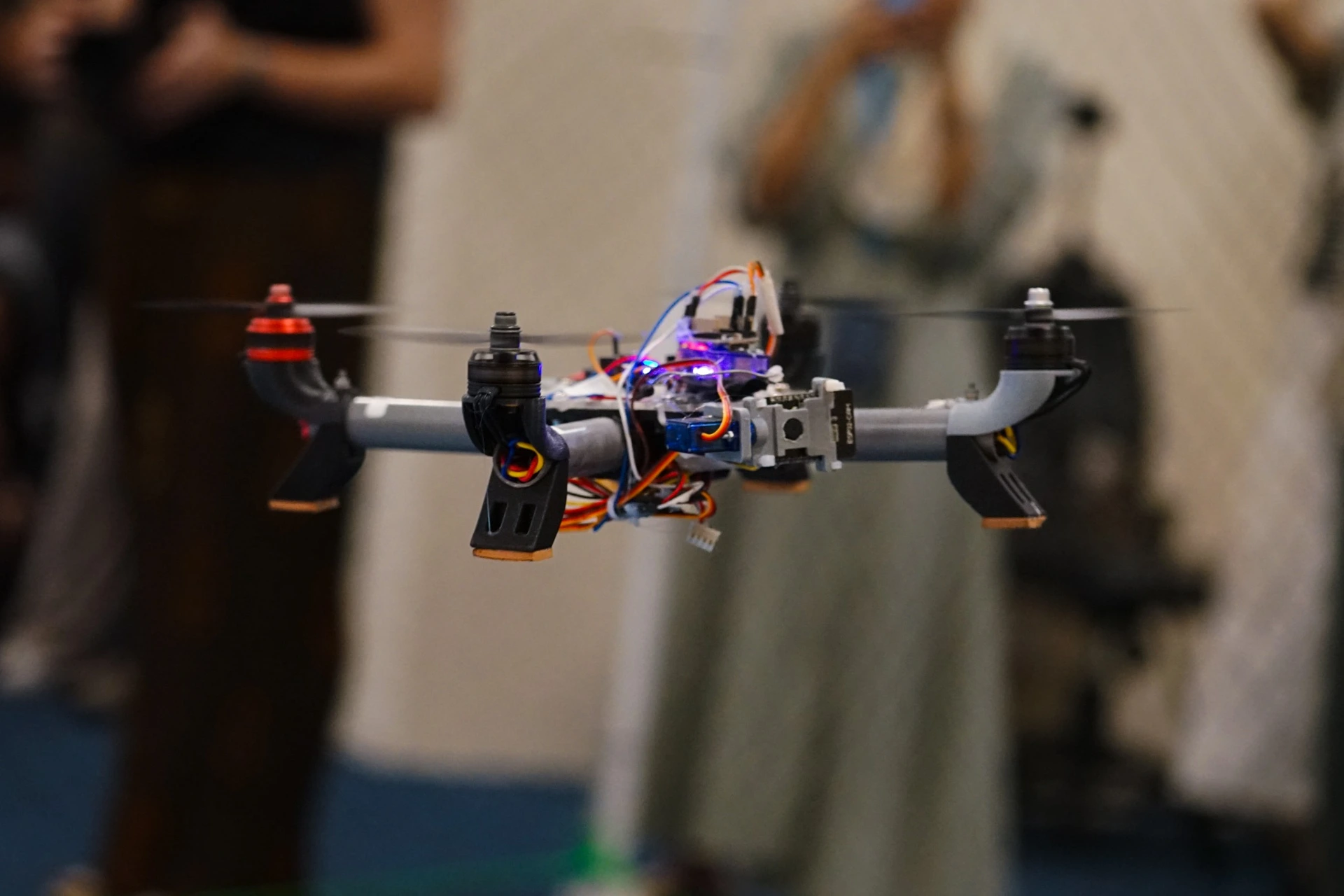
On presentation day, it wouldn’t take off.
After months of design iterations, tuning and late nights, we had a drone that flew. It had run successfully the day before. Then, in front of students, supervisors and assessors, it refused to take off.
Some flight settings had reset. I led the troubleshooting and recovery while the clock was ticking. We opened Betaflight, reconfigured what we could and re-armed the aircraft. Then it flew: takeoff, hover and landing.
And then it flew.
This is the flight from our presentation. After everything we’d worked through, seeing it take off in front of the room was a huge relief.
Original demonstration footage · approximately 41 seconds · playback controls and sound available.
A small aircraft. A lot to fit inside it.
The brief brought mechanical design, electronics and control together in one compact multirotor. We were working towards a 640 g mass limit, with a self-levelling camera gimbal and a modular structure that could be assembled quickly. The requirements also included onboard recording.
I led a six-person team through design, manufacture, integration and testing. I coordinated the CAD, structure, propulsion, electronics and manufacturing work. When something went wrong, I had to help work out where the problem was and what we needed to do next.
Getting the systems to work together.
This was far more than assembling a drone. We worked through CAD modelling and structural design, laser cutting and 3D printing, soldering and wiring, flight-controller integration, ESC configuration, motor calibration and PID tuning.
Getting each part working was one thing. Getting the whole drone working was much harder. A vibration or configuration problem could affect the flight even when the individual components seemed fine.
There was plenty to troubleshoot.
We burned motors, had crashes and repairs, dealt with mid-air oscillations and worked through system resets. At times it felt as though anything that could go wrong had gone wrong. My team and I kept working through it.
One configuration problem we worked through was a receiver that stopped responding after a firmware upgrade. Correcting the Serial RX/UART configuration restored it. That happened earlier in development, separately from the presentation-day reset. It was one of the many times we had to retrace our steps to find what had changed.
What we delivered.
The integrated UAV achieved stable flight and image capture during final testing. Its final mass was 650 g against a 640 g requirement: 10 g, or about 1.6%, over the limit.
Presentation day is still the part I remember most. I led the troubleshooting with everyone watching, and we got it back in the air. I’m proud of that, and grateful to my team for sticking with it through all the repairs and late nights.
| Item | Outcome |
|---|---|
| Flight demonstration | Takeoff, hover and landing achieved |
| Image capture | Achieved during final testing |
| Aircraft mass | 640 g target / 650 g achieved |