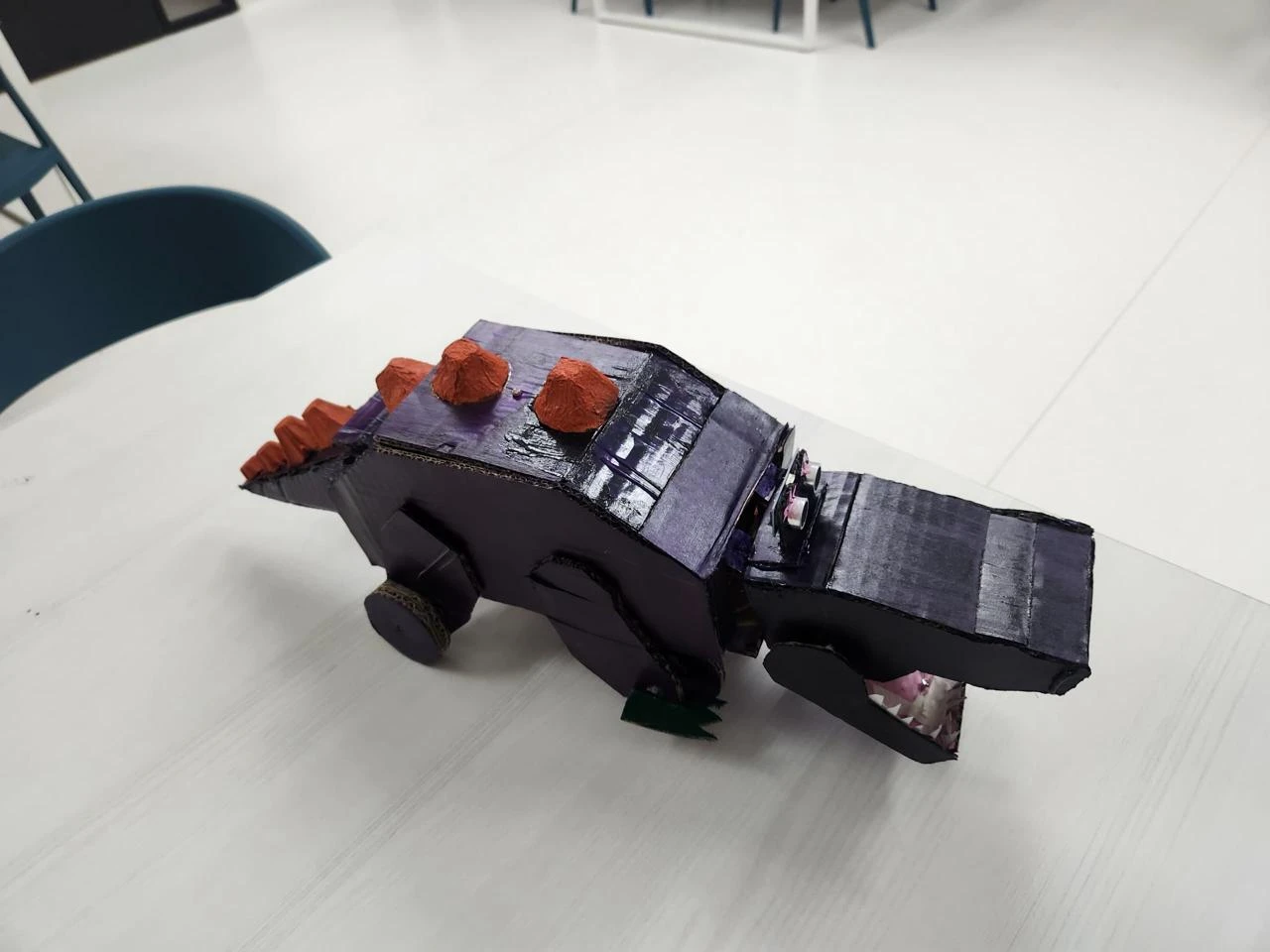
Yes, we built a dinosaur.
This was one of my earlier robotics projects. Our team built an Arduino-powered dinosaur with a cardboard body, sensors and moving parts. We wanted it to react to what was happening around it, rather than just repeat a fixed sequence.
My work focused on the control logic and interactive behaviour. I also helped with the mechanical packaging, electronics integration and testing as we brought it together.
Here’s me
walking through it.
The project video shows the robot up close while I present it. The photos below also show the build before the body was closed up.
Original project video · About two minutes · Sound available through the player.
Making it curious. Or scared.
The behaviour code used ultrasonic distance readings to decide how the robot should respond. In curiosity mode, it could approach something nearby. In fear mode, a close, fast approach triggered retreat and a buzzer sound.
Those were behaviours we programmed using sensor thresholds. Calling them “fear” and “curiosity” was a way of giving the robot character, not a claim that it understood emotion.
What was inside it?
The build used an Arduino, ultrasonic sensors, stepper-driven movement, servos for the jaw and tail, and a buzzer. The code also included a light-dependent resistor for a tail response and logic for edge detection.
My part was getting the sensor readings to drive the intended behaviour, then testing that logic with the hardware. The mechanical packaging mattered too: we had to fit the wiring and moving parts inside the body while keeping them accessible during the build.
A team build I enjoyed.
I liked that this project gave us room to be creative with both the appearance and the behaviour. We had a physical robot to work on, and I could connect the programming directly to something moving in front of me.
It was an early opportunity to work across sensing, code and mechanical parts in one project. The video is our project presentation, rather than a quantified test of every behaviour in the code.